 Perilous
 Classes
Classes are paths laid over a classic skill-based shard. Your class is a bonus layer, not a cage - and you can change it.
How Classes Work
Perilous Legends is a skill-based shard first. You build your character out of skills, and no content on the shard is locked behind a class. A class is a layer you choose on top of that skill template: it gives you a level track and passive perks that reward playing to a theme, and it never walls anything off from the classes that did not pick it.
Put plainly: the class does not decide what you are allowed to do, it decides what you are a little better at doing. Every dungeon, boss, town and system is open to all. Pick the class whose gameplay style you want to lean into, then keep playing the game you were going to play anyway.
You carry one active class at a time. It sits alongside your skills, tracks its own level, and quietly hands you its bonuses while it is the one you have equipped.
Class perks are for fighting monsters. A class's passive bonuses and its proc abilities switch off while you are flagged in player-versus-player combat, so classes do not turn PvP into a numbers race. They shape how you hunt, not how you duel.
Leveling Up
Class levels run from 0 to 14. You raise them in two steps, and the second step is the part people forget:
- Earn XP by earning gold. Ten percent of the gold or plunder a monster, treasure chest, or ship drops is banked as XP for your active class. Kill things, take gold, fill the bar. Only your active class earns XP. The one exception is the Artisan, which earns nothing from kills and levels by the materials it crafts with and gathers.
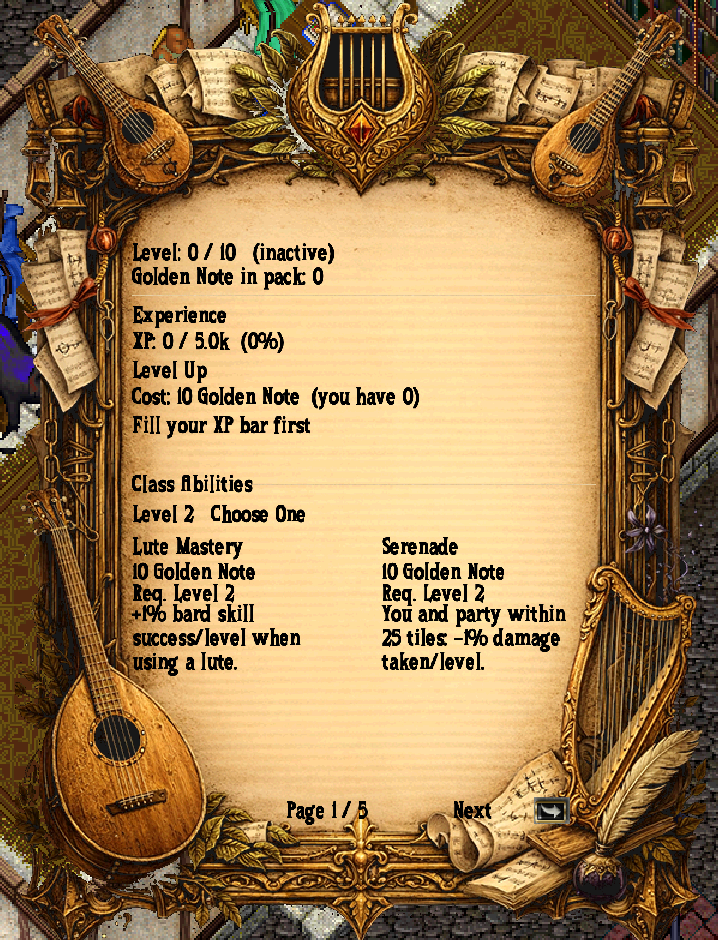
- Cash it in at your Guildmaster. The XP bar fills to a threshold and then stops. It does not level you automatically. To actually gain the level you visit your class Guildmaster (an NPC, see below) and pay class coins.
The thresholds double every level, so early levels come fast and the last few are a grind:
| Level | XP needed | Level | XP needed |
|---|---|---|---|
| 1 | 5,000 | 8 | 640,000 |
| 2 | 10,000 | 9 | 1,280,000 |
| 3 | 20,000 | 10 | 2,560,000 |
| 4 | 40,000 | 11 | 5,120,000 |
| 5 | 80,000 | 12 | 10,240,000 |
| 6 | 160,000 | 13 | 20,480,000 |
| 7 | 320,000 | 14 | 40,960,000 |
The coin cost to buy a level is simple: the target level times ten. So stepping from 4 to 5 costs 50 coins, and the jump to 14 costs 140. You need both the banked XP and the coins in hand.
Class Coins
Each class spends its own coin. You do not have to be that class to find them, though: coins drop for everyone, so a Ranger will pick up Doubloons and a Pirate will pick up Hunter's Marks just by killing things. The drop chance scales with how tough and famous the monster is. Weak creatures almost never cough one up, while a champion or boss is close to guaranteed. There is also a universal wildcard, the Prism Coin, which can stand in for any class's coin when you level or buy an ability. See Class Coins for the full list and drop odds.
| Class | Coin | Class | Coin |
|---|---|---|---|
| Pirate | Doubloon | Gladiator | Glory Token |
| Necromancer | Soul Shard | Biologist | Specimen |
| Bard | Golden Note | Assassin | Contract Mark |
| Elementalist | Essence | Cutpurse | Shadow Coin |
| Ranger | Hunter's Mark | Artisan | Guild Crest |
| Any class | Prism Coin (wildcard, stands in for any of the ten) | ||

Fork Abilities
Leveling is not just a bigger number. At levels 2, 4, 6, 8, 10, 12 and 14 your class offers a fork: two abilities, and you buy one of them with class coins at your Guildmaster. The two options at a tier are mutually exclusive, so a class is not one fixed kit, it is a small tree you shape as you climb. Two players of the same class can play quite differently depending on which side of each fork they took.
The choice is not locked forever. If you want the other option later, you can respec that tier at the Guildmaster and pick again. The catch is that the coins you already spent are not refunded, and you pay again for the new choice, so it is a real decision rather than a free toggle.
On top of the fork abilities, every class also carries passive bonuses that scale with its level - things like more gold from kills, better odds on a skill, or a small edge in its signature situation. Those apply automatically as you level and do not cost coins.
The specific abilities on each fork are shown on the Guildmaster panel in-game, where you can read both options before you commit a level's coins. This wiki keeps the class pages to role and playstyle rather than listing choices that are best read live, at the NPC, right before you buy them.
Switching Classes
Classes are not locked in. You are never stuck with your first pick - but changing is a deliberate act, not something you flip mid-fight.
- Your first class is free and instant. A brand-new character has no class; the first one you choose applies immediately, with no cooldown and no channel.
- After that, changing takes a channel. Swapping to a different class starts a 2-minute channel. You are frozen in place for the duration, and taking any damage cancels it - as does logging out or dying. Do it somewhere safe.
- There is a 15-minute cooldown between swaps. Once a change completes, you wait fifteen minutes before you can start another. You commit to a class for a while, not for a single pull.
- Dismiss your summons first. If you have summoned creatures out (a Necromancer's undead, for instance), you must dismiss them before the swap will start.
The saving grace is that each class keeps its own level. Switching to Assassin does not wipe the Pirate levels you already bought - they are waiting for you when you swap back. That makes it worth grinding a second class over time.
Class vs. Your Build
Your class and your skills are two separate systems, and it is worth keeping them straight. Your class is the perk layer described on this page. Your actual skills and stats live in the Personality build system, which lets one character hold several complete skill sets and swap between them. Changing your class does not touch your skills, and swapping your build does not touch your class. Full details are on Skills & Stats.
The Ten Classes
Here is the roster. Every class is viable, every class can go anywhere. Click through for how each one actually plays.
| Class | Coin | Role & theme |
|---|---|---|
| Pirate | Doubloon | Swashbuckling sea raider: cutlass, cannon, and a deck under your feet. |
| Necromancer | Soul Shard | Dread caster who trades in death magic and fear. |
| Bard | Golden Note | Instrument-wielding controller who turns the room against itself. |
| Elementalist | Essence | Raw-element mage channeling fire, water, earth and storm. |
| Ranger | Hunter's Mark | Bow-and-wilderness hunter who fights at range and reads the land. |
| Gladiator | Glory Token | Plate-clad melee anchor built to stand in the front and stay there. |
| Biologist | Specimen | The shard's naturalist: creatures, reagents and living things. |
| Assassin | Contract Mark | Poisoned-blade stalker who opens from stealth and closes fast. |
| Cutpurse | Shadow Coin | Light-fingered thief: stealth, stealing, and being gone before it is noticed. |
| Artisan | Guild Crest | Crafter and gatherer: forge, loom and mine, leveled by working instead of killing. |