 Perilous
 Hamlets & Siege
Fortified territory a guild can take, hold, and profit from - if it can defend the walls.
Overview
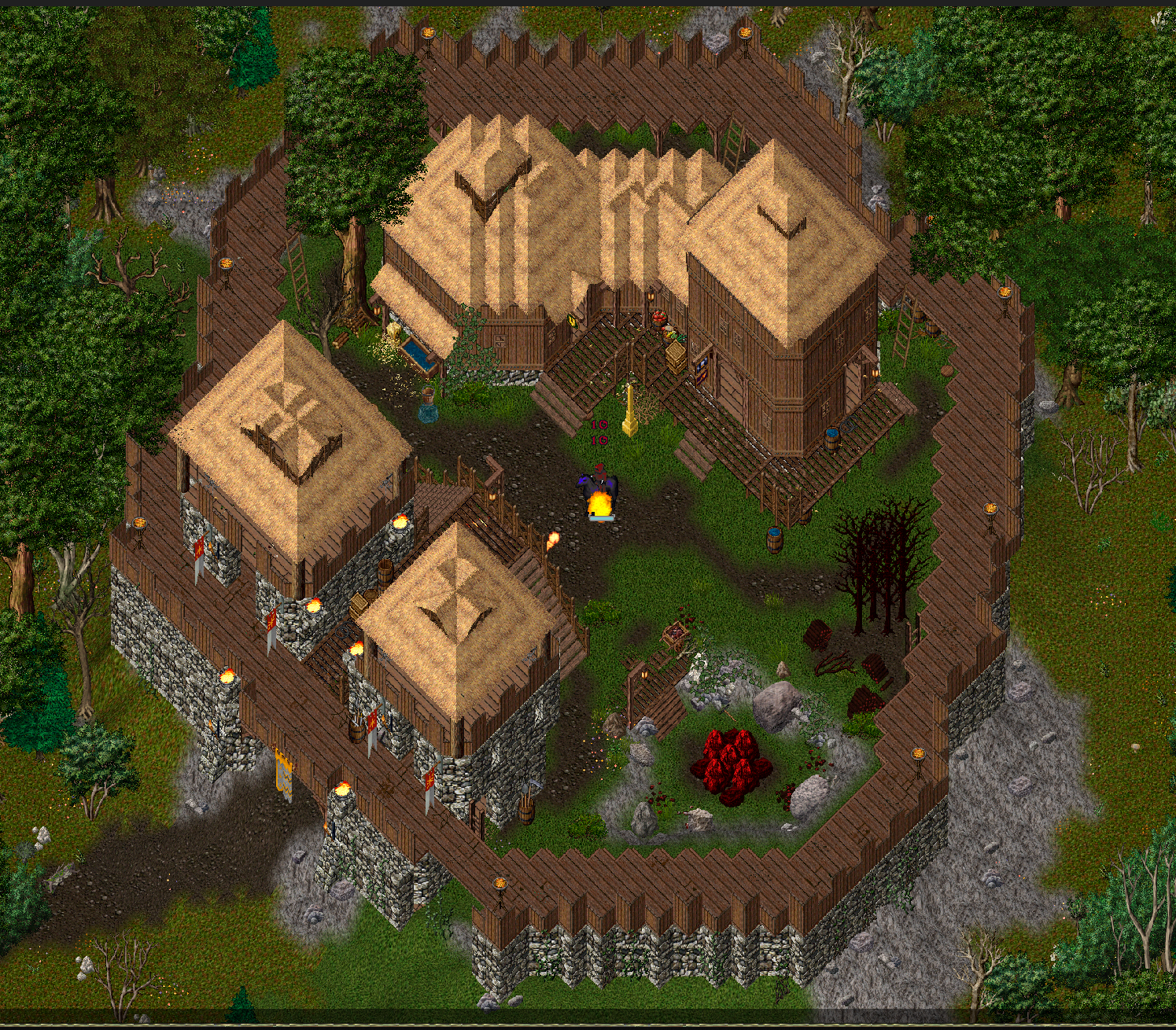
A hamlet is a walled settlement out in the world that a guild can own outright. Whoever holds it gets the top-tier resources inside its walls and a private stronghold to run from - and a standing invitation for every rival guild to come take it away. Control changes hands through siege: batter the walls down, out-hold the defenders for the length of the fight, and the hamlet is yours.
The Obelisk
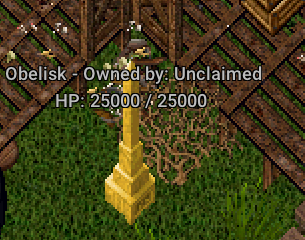
Every hamlet is anchored by an Obelisk. It records which guild owns the place and the hamlet's name, and taking the hamlet in a siege is what flips it over to the winning guild. The obelisk has 25,000 hit points and cannot be scratched outside of an active siege - it is invulnerable until the attack goes live, and then it is the attackers' final target.
It is also the maintenance hub. Any player can walk up and double-click it to open the repair panel and patch up the settlement's damage (see Repairing the Hamlet).
Taking a Hamlet
A siege is a multi-day operation with a strict order of events. You cannot skip to the obelisk - you have to earn your way in first.
- Break the walls. The outer walls can be attacked at any time - no declaration is needed to start hitting them, and only siege weapons can hurt them. Every hamlet is lawless inside its walls and for 30 tiles beyond them in every direction. Damaging any of a hamlet's structures makes you an enemy of the guild that owns it: you and every member of that guild show orange to each other for one hour after your last hit, so either side can attack without a criminal flag or a murder count.
- Buy a Siege Stone. The attacking guildmaster buys a Siege Stone from a banker and keeps the deed in their pack.
- Declare the siege. The guildmaster uses the Siege Stone Deed and targets the enemy obelisk. This opens a 1-hour window to plant the stone.
- Plant the Siege Stone. Place it 101-150 tiles from the obelisk, on legal ground (no water, mountain, house, boat etc). Planting it sends a world-wide message to the whole server and starts the countdown to the live siege.
- The countdown. From the moment the stone is planted, the defending guild gets a reminder every 30 minutes. For the first 12 hours the timing is fixed. After that, the defenders take the clock: at any point in the 12-to-18-hour window the defending guildmaster or an officer may choose when the fight happens, which gives everyone 6 hours notice - the siege then goes live 6 hours after they initiate. If the defenders never choose, the siege starts on its own at the 24-hour mark.
- The siege goes live. When the fight begins, the settlement's interior becomes vulnerable for a 90-minute window. This is the only time the obelisk can be damaged - now it, along with the towers, vault and resource nodes, is fair game.
- Win the fight. Attackers win by destroying the obelisk. The defenders win by destroying the attackers' Siege Stone, or by simply surviving until the 90-minute clock runs out.
The stakes are real gold. The Siege Stone the attackers plant has 10,000 hit points and is invulnerable until the siege goes live - if the defenders smash it during the live window, 500,000 gold is deposited into the defending guildmaster's bank and the attack is broken. Let the clock expire without cracking the obelisk and the defenders keep the hamlet. Take the obelisk down and ownership transfers on the spot.
Walls, Gate & Towers
The defenses are all real, destructible objects with their own health, and only siege weapons can damage them:
- Walls ring the settlement at roughly 2,500 hit points per section. When a section is destroyed it drops away completely and you can walk straight through the gap. Broken sections can be rebuilt at the obelisk between assaults.
- The gate is the tougher part of the ring, around 5,000 hit points. It never swings open. Instead, a member of the controlling guild double-clicks the gate to be teleported to the far side - because the gate does not actually open, no enemy can follow them through. Outsiders get nothing but a refusal. Break the gate (or any wall) and that free passage becomes a hole anyone can use.
- Guard towers defend the interior once a siege is live. Each tower has 10,000 hit points and, every few seconds, throws a fireball at every hostile standing inside the walls - about 10 damage a hit, and hidden players are targeted too, so you cannot stealth past them. Their reach is the walled interior plus one tile: melee attackers hammering a wall are in range, but siege gear fired from two or more tiles out stays safe.
On top of the physical walls, a magical ward covers the ground around a claimed obelisk: only members of the owning guild can recall or gate into or out of the area within about 100 tiles of it. Outsiders trying to teleport in or out are turned away. Between the ward and the guild-only gate, a hamlet is genuinely hard to get into unless you break your way in.
The Spoils
Inside the walls sit the assets a guild is really fighting over:
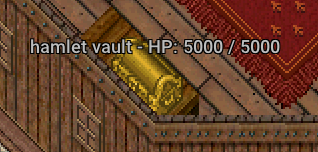
- A bank vault - a strongbox of 5,000 hit points. While it stands, anyone can double-click it to open their bank on the spot. Breach it during a siege and it scorches and smokes, and the hamlet's banking goes offline until the vault is repaired.
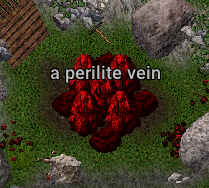
- A Perilite mine and a Perilwood grove - the hamlet's resource nodes, and the shard's only source of its top-tier ore and lumber. The veins and trees are individually destructible, so asset damage can shut down the guild's harvest by smashing the nodes. See Perilite & Perilwood.
- A Major (Q4) Enchanting Table - the highest-grade Enchanting Station in the game. A hamlet is the only place one exists; towns carry the Minor tables, Q1 through Q3. See Enchanting & Skinning.
Siege Weapons
Ordinary weapons do nothing to walls. You need purpose-built siege gear, which players craft at the bench. Each weapon and its recipe is listed below.
| Weapon | How it works | Crafting |
|---|---|---|
| Siege Hammer | Melee; 20 siege damage a swing, auto-swinging the same structure. Hits structures only - it will not swing at a living target. Unlimited use. | Blacksmithy 100. 100 iron ingots + 25 boards. |
| Battle Spike | Thrown like an explosion potion; 50 siege damage to every structure in a 2-tile blast, on a 5-second cooldown. Consumable and stackable. | Alchemy 100. 1 empty bottle + 5 iron ingots + 5 sulfurous ash. |
| Siege Cannon | A placed engine (within 100 tiles of the obelisk) that fires cannonballs to 25 tiles - 100 damage to structures plus 50 to any players and pets caught in the blast. The cannon itself has 1,500 HP and decays after 30 minutes; defenders can place one too. | Blacksmithy 100 + Tinkering 100. 100 valorite ingots + 50 frostwood boards. Crafts a Siege Cannon Deed you double-click to assemble. |

On defense, the Arcane Set - a ring, necklace and earrings crafted through Tinkering - is what lets you survive under the guard towers. Each piece cuts the tower fire you take by a quarter, and the full set of three cuts it by three quarters. Each piece takes Tinkering 120 and 10 valorite ingots plus 25 gems: 25 diamonds for the ring, 25 emeralds for the necklace, and 25 rubies for the earrings.
Repairing the Hamlet
Every structure except the obelisk can be damaged - and mended - at any time, whether or not a siege is running. Only the obelisk is untouchable outside the live 90-minute window. Walk up to the Obelisk and double-click it to open the repair panel. It lists six categories of damage - Guard Towers, Walls, Gates, Bank Vault, Perilwood Grove and Perilite Mine - each showing how badly it is hurt, with a Repair button.
Repairs are powered by Hamlet Repair Deeds, crafted by a Carpenter from one blank scroll, 50 boards and 25 ingots. Outside the live siege, each repair is a normal 5-second channel that locks you in place with a mining animation - move or take damage and it cancels - and spends one deed to heal a fixed chunk of that category. During the live 90-minute siege the work gets much harder: each repair costs ten deeds and takes twice as long. A category has to be healed all the way to full before it snaps back, and then everything in it returns at once: broken walls remade, veins and trees and gates back, towers powered up, and the vault a working bank again.
The same panel has a Destruction Log anyone can open. It shows the last 24 hours of losses - what was destroyed, when, and who dealt the most damage to it - so a guild can see exactly who has been chipping at their walls.
The Ethereal Garuda
Holding a hamlet earns the guild a trophy you cannot craft or buy: an ethereal Garuda mount, granted to the guildmaster of the controlling guild. It is a great winged Garuda, an unmistakable statement of who owns the ground you are standing on.
It is locked to the role, not the person, and the shard checks that live every time it is used. Only the current guildmaster of the guild that currently controls the hamlet can summon or ride it. If leadership changes, or the guild loses the hamlet, the old mount is revoked and the rightful guildmaster is issued the correct one - and it can never be traded or handed off. Lose the hamlet and the bird flies off with it.
Exact hit-point totals, damage values and timers are set in-game and can be tuned; a few numbers on this page are the intended beta values. It describes how the siege behaves, not a frozen spec. For the flying mount itself, see Mounts & Flight.